
 Tiếng Việt
PALLETIZER SYSTEM – STRUCTURE AND OPERATING PRINCIPLE
Palletizers represent a leading automation solution that helps businesses completely optimize the end-of-line palletizing process. Join ETEK in exploring the detailed structure and operating principles of this system in the article below.
What is a Palletizer System?
Palletizer System (or automated palletizing machine/line) is an industrial automation solution designed to automatically gather, arrange, and stack finished products-such as carton boxes, bags, Jumbo bags, bottles, or cans-onto pallets according to a predefined pattern.
Typically positioned at the end of the packaging line, palletizers serve as a crucial bridge between production/packaging and warehousing or transport. Today, automated palletizing solutions on the market are divided into two main technologies:
- Traditional Palletizers: Use mechanical systems, push plates, and mechanical lifting tables to stack goods layer by layer.
- Robotic Palletizers: Utilize industrial robotic arms equipped with specialized grippers or vacuum heads to flexibly move individual products or product clusters. This modern approach is preferred by many manufacturing plants.
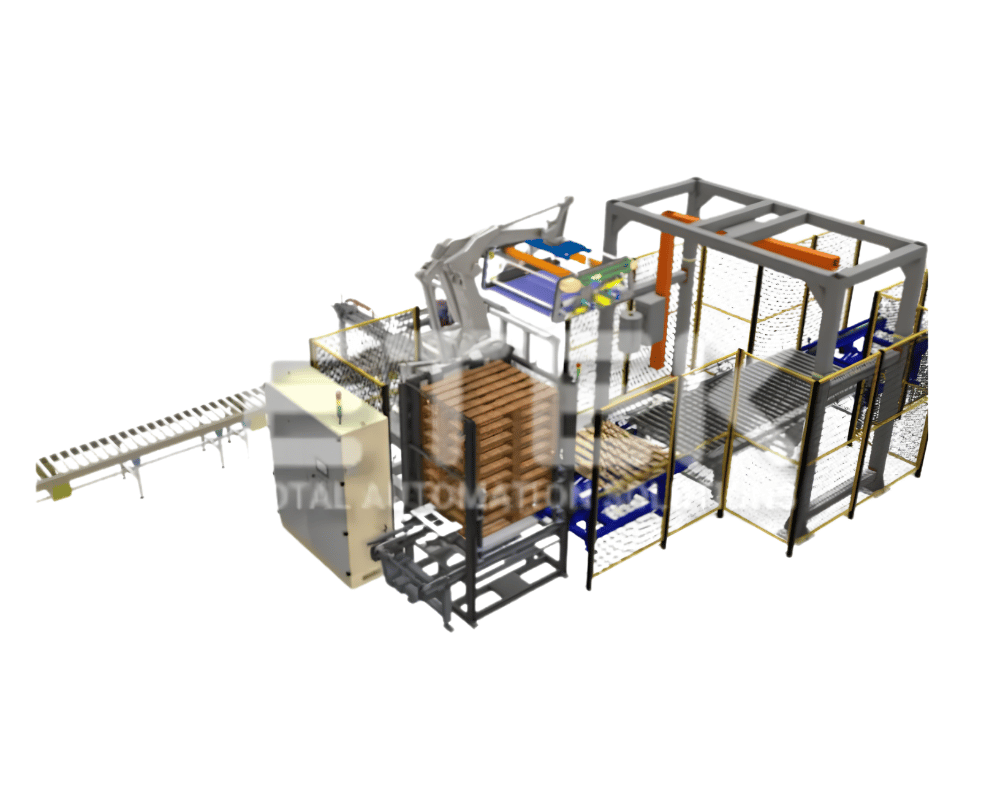
Structure of a Palletizer System
To operate continuously with high precision and speed, a standard palletizer system comprises several synchronized subsystems. Despite variations in design, a palletizer system typically includes the following core components:
- Infeed Conveyor: Transfers finished products from the end of the packaging line to the stacking area, flexibly utilizing roller, chain, or modular plastic belt conveyors based on packaging characteristics.
- Product Orientation System: Automatically adjusts, rotates, and aligns product positioning accurately according to pre-programmed stacking patterns.
- Layer Forming Table: Gathers individual products and arranges them into a complete layer using stoppers, pushers, or robotic arms.
- Specialized End-of-Arm Tooling (EOAT/Gripper): Directly picks and places products onto the pallet, with flexible options such as vacuum suction heads, mechanical clamps, or bottom-support lifting plates.
- Lifting/Lowering Mechanism: Controls the elevation of the lift plate/table smoothly up and down to gently place each formed layer onto the pallet.
- Automatic Pallet Dispenser: Stores and automatically dispenses empty pallets into the workstation one by one without requiring manual intervention.
- Pallet Transport Conveyor: Heavy-duty conveyor system responsible for moving empty pallets into the loading zone and transferring fully loaded pallets out of the station.
- Automatic Slip Sheet Inserter: Automatically picks and places cardboard or plastic divider sheets between layers to enhance stability and moisture resistance.
- Control System: Integrates PLC processors, HMI touchscreens, and safety sensor networks to manage the entire operating cycle and provide instant fault alerts.
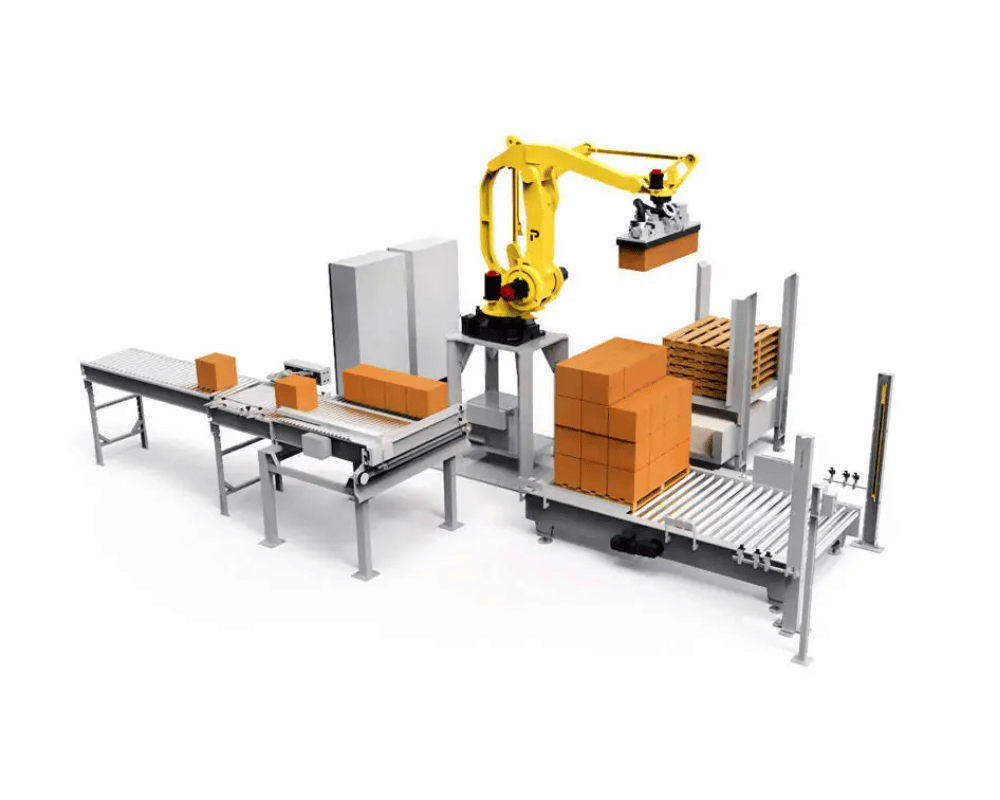
Operating Principle of a Palletizer System
Despite its complex engineering, the operating principle of palletizer system relies on a sequence of fully automated, synchronized operations coordinated between actuators, smart sensor arrays, and a central controller. The entire cycle is optimized for specific stacking patterns based on packaging type, progressing through the following main steps:
- Empty Pallet Supply: To begin the cycle, the automatic dispenser pushes a new empty pallet into the workstation and secures it in position, ready to receive goods.
- Product Infeed and Detection: Finished products move along the conveyor from the packaging line into the picking zone. Sensor arrays immediately detect, precisely locate, and direct the products.
- Arrangement and Layer Formation: Robotic arms or mechanical pushers pick, transfer, and place products onto the pallet according to the programmed pattern. Products can be placed individually or in groups to form neat, precise layers.
- Automatic Height Adjustment: Once a layer is completed, the stacking table lowers by the exact height of that product layer, maintaining the operational surface at an optimal working height.
- Cycle Repetition: The sequence of receiving, transferring, placing, and lowering repeats continuously until the stack reaches the designated layer count or height.
- Full Pallet Discharge: Once the pallet load is completed, the system automatically activates the outfeed conveyor to transport the full pallet to stretch wrapping or storage, while immediately dispensing a new empty pallet to start the next cycle without interrupting production.
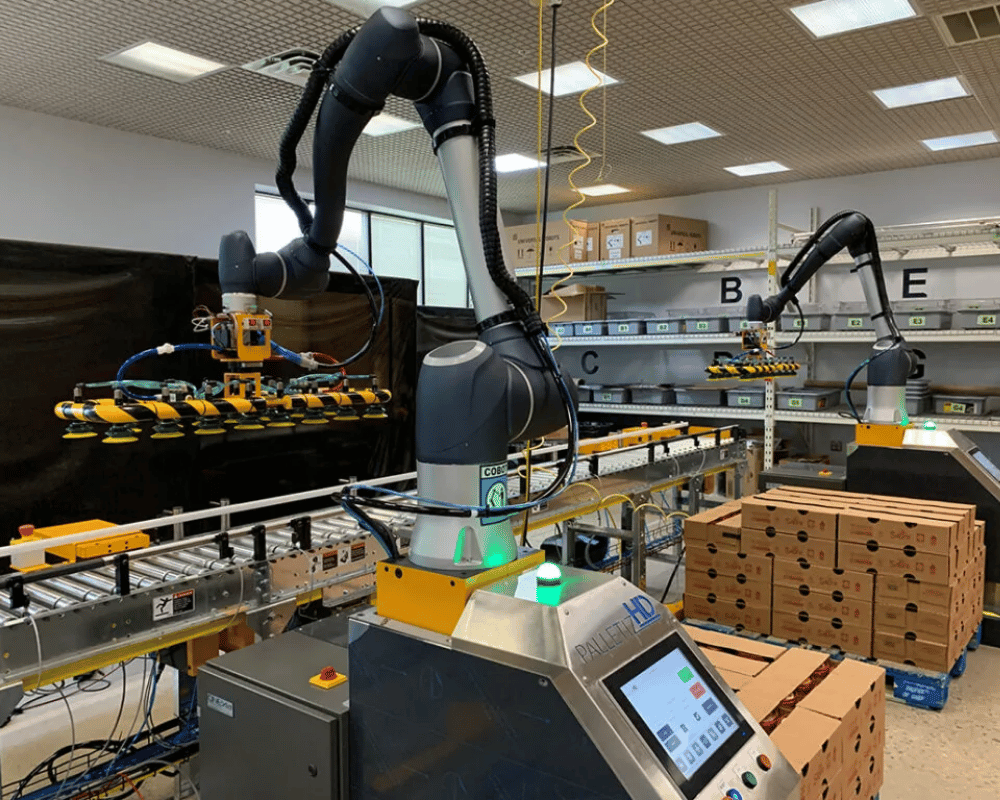
Applications of Palletizers
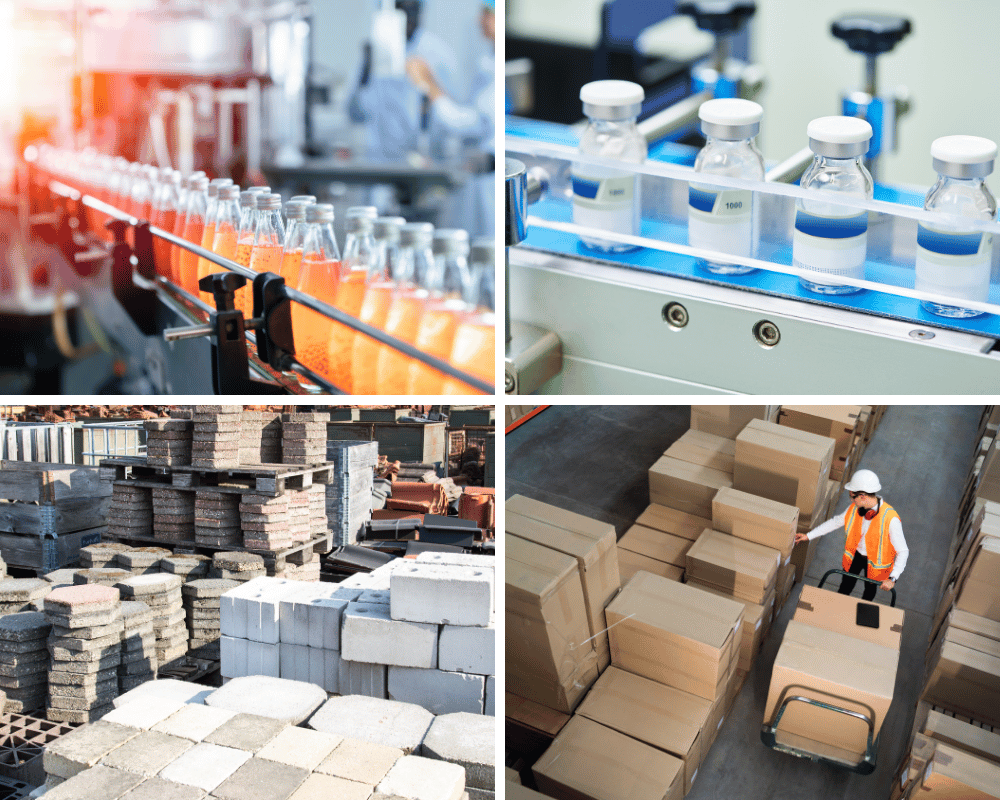
By automating pallet stacking at high speeds, high accuracy, and exceptional safety, palletizers have become a key solution helping factories standardize packaging processes, minimize labor costs, and boost operational efficiency. Below are key industries utilizing this technology:
- Food & Beverage (F&B): This sector represents the largest user base of palletizers. The system neatly and rapidly stacks carton boxes, shrink-wrapped bundles, or crate cases onto pallets in square, stable patterns. In environments with strict hygiene requirements, it minimizes manual human contact.
- Pharmaceuticals & Personal/Home Care: Flexible robotic palletizers are preferred for handling small, delicate items such as medicine boxes, cosmetic jars, or shampoo bottles with high precision. This solution easily integrates with inspection cameras and checkweighers, fully complying with GMP standards for quality control and traceability.
- Building Materials, Fertilizers & Animal Feed: For heavy bagged products (ranging from 25 to 50 kg), heavy-duty palletizing systems completely eliminate manual labor and sustain high-capacity handling of hundreds of tons per day.
- Logistics & Warehousing: Modern palletizer technology supports mixed-pallet stacking, optimizing storage space, accelerating order processing, and reducing truck turnaround times—establishing a solid foundation for Smart Warehousing in the Industry 4.0 era.
Reputable Palletizer System Supplier
As a pioneer in Industrial Automation and System Integration in Vietnam, ETEK provides turnkey palletizer system solutions tailored specifically to the practical operational challenges of each plant.
With a proven track record across hundreds of automated packaging line projects operating smoothly in plants across Northern and Southern Vietnam as well as international markets, ETEK has established its leadership position in the industry. Furthermore, ETEK has demonstrated its technical prowess by expanding into demanding international markets with stringent quality and technical standards, such as South Korea.
Contact our hotline at 0866 533 986 today to consult with ETEK’s expert engineering team and receive an optimal quote for your customized palletizer system!