
 Tiếng Việt
Column-Type Depalletizer Robot: A Depalletizing Solution for Payloads up to 80kg
At the start of many production lines and logistics operations, workers have to manually unload individual carton boxes, bags, cans, or raw material packages from pallets onto conveyors. This repetitive, strenuous task lasts all shift, easily causes back pain, and acts as a bottleneck that slows down or interrupts the entire downstream line.
The depalletizer robot was created to solve this exact stage. In this article, ETEK introduces the column-type depalletizer robot-a 4-axis robot with an 80kg payload and 2000 mm reach—along with its working principle, advantages, applications, and selection criteria.
What Is a Depalletizer Robot?
Depalletizing is the reverse process of palletizing: removing individual boxes, bags, or layers of goods from a pallet to feed into subsequent stages such as packaging, filling, inspection, sorting, or outbound shipping.
A column-type depalletizer robot s a 4-axis industrial robot featuring a vertical column structure. Its arm moves up and down along the column, rotates, and extends to position the gripper accurately over the stack, picks up the products, and transfers them to a conveyor or the next workstation.
Because its structure consists only of essential movements—rotation, extension, vertical lifting/lowering, and wrist rotation—the robot is simpler, more durable, easier to program, and easier to maintain than multi-axis articulated robots.
You may also encounter other terms for it: automatic depalletizing machine, pallet unloading robot, or depalletizing robot.
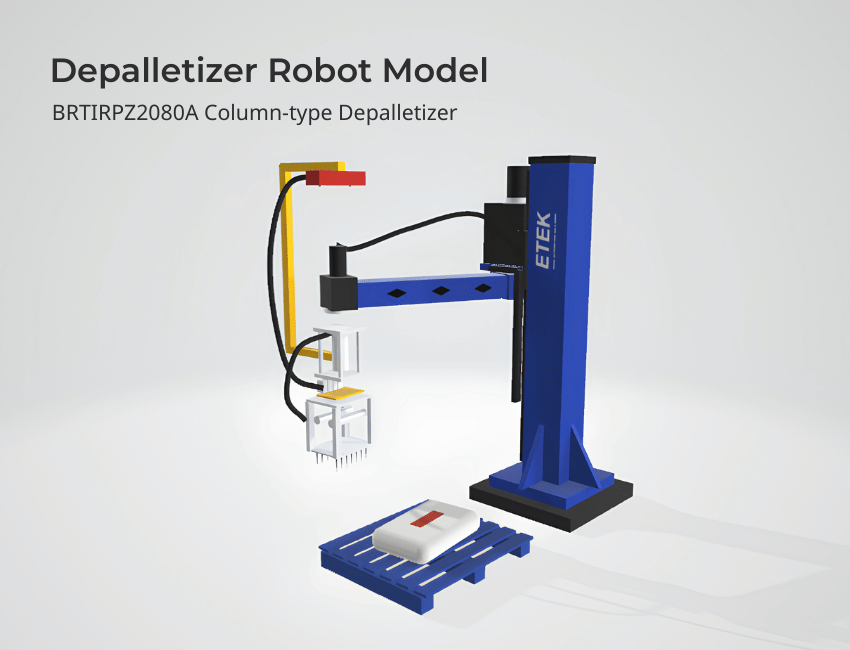
Introduction to the BRTIRPZ2080A Depalletizer Robot
The BRTIRPZ2080A Depalletizer Robot is a 4-axis column-type depalletizer robot designed for monotonous, repetitive, long-duration tasks, or operations in hazardous and harsh environments. With capabilities for loading/unloading, material handling, and depalletizing, it is particularly well-suited for infeed depalletizing stages.
Key Highlights:
- 2000 mm reach: Covers a wide working envelope, handling multiple pallet and conveyor positions.
- 80 kg maximum payload: Capable of handling heavy carton boxes, bags, cans, plastic crates, and large packages.
- ±0.15 mm repeatability: Picks and places with high precision, ensuring products land neatly on the conveyor while minimizing jams or drops.
- 1800 mm vertical stroke, 1700 mm max operating height: Reaches tall pallet stacks (depending on end-of-arm tooling and material characteristics).
- IP40 protection rating: Suitable for standard factory environments.
- Flexible degrees of freedom: Accommodates unloading, handling, depalletizing, and feeding operations.
Technical Specifications of the BRTIRPZ2080A Robot
| Item | Specification |
| Model | BRTIRPZ2080A |
| Robot Type | 4-axis, column-type |
| Arm Reach | 2000 mm |
| Maximum Payload | 80 kg |
| Repeatability | ±0.15 mm |
| Vertical Stroke | 1800 mm |
| Max Operating Height | 1700 mm (depending on tooling and material) |
| Power Requirement | 6 kVA |
| Robot Weight | 689 kg |
| Protection Rating | IP40 |
Range of Motion and Maximum Speed by Axis:
| Axis | Operating Range | Maximum Speed |
| J1 (Base rotation) | ±100° | 129.8°/s |
| J2 (Vertical stroke) | 1800 mm | 222 mm/s |
| J3 (Elbow rotation) | ±145° | 360°/s |
| J4 (Wrist rotation) | ±360° | 298°/s |
Note: Specifications are subject to change based on order configuration. Please contact the supplier for confirmation based on actual requirements.
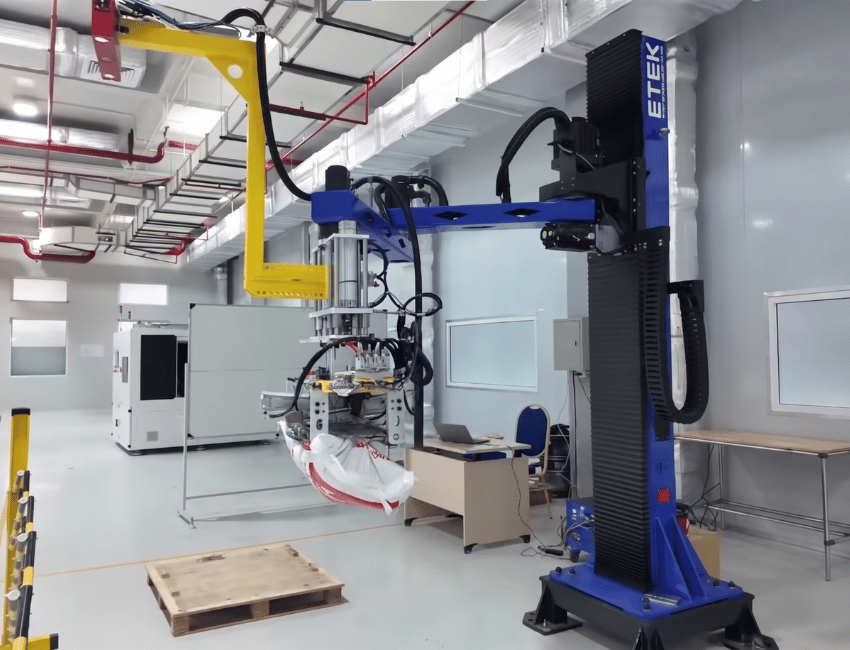
How Does a Depalletizer Robot Work?
A typical depalletizing station operates through a 5-step process:
- Pallet positioning: A forklift, roller conveyor, or AGV delivers the loaded pallet into the robot’s working zone.
- Load detection: Sensors (or cameras) detect the layer height and box positions. For pallets stacked in a fixed pattern, the robot can run on a pre-programmed path.
- Picking: The end-of-arm gripper (vacuum, mechanical clamp, or hybrid) picks up individual boxes or an entire layer. The robot gradually lowers itself layer by layer via its vertical axis.
- Transferring to the conveyor: The robot rotates and places the goods onto the conveyor with high precision so downstream processes run smoothly.
- Empty pallet handling: Once unloaded, the empty pallet is removed, and a new full pallet takes its place. If slip sheets are present between layers, the robot or an auxiliary mechanism can remove them.
The vertical axis is the key advantage of a column-type robot: instead of folding and extending complex joints to reach low or high layers, the robot simply moves up and down along the column, making operations both stable and easy to control.
6 Key Advantages of Column-Type Depalletizer Robots
Relieves workers from heavy manual labor
Continuously unloading 20–80kg boxes is a leading cause of spinal injuries. When the robot takes over this task, workers can transition to supervision and quality inspection roles.
Ensures steady feeding for the production line
The robot unloads goods at a consistent pace, supplying downstream filling, packaging, case-opening, or inspection machines continuously—eliminating bottlenecks and starvation.
80kg payload handles diverse product types
Simply by changing the gripper and program, a single robot can handle various packaging formats: carton boxes, bags, cans, plastic crates, and bundles.
High precision minimizes product damage
±0.15 mm repeatability ensures goods are placed accurately on the conveyor, reducing drops, misalignment, jams, and product damage.
Simple structure with minimal breakdowns
With fewer joints than a 6-axis robot, there are fewer wear points, making maintenance easier and operating costs lower. This is ideal for factories without a large team of robotics engineers.
Easy integration and retrofitting onto manual lines
The robot integrates seamlessly with conveyors, case openers, filling machines, and automatic pallet dispensers, allowing you to automate step-by-step rather than overhauling the entire facility at once.
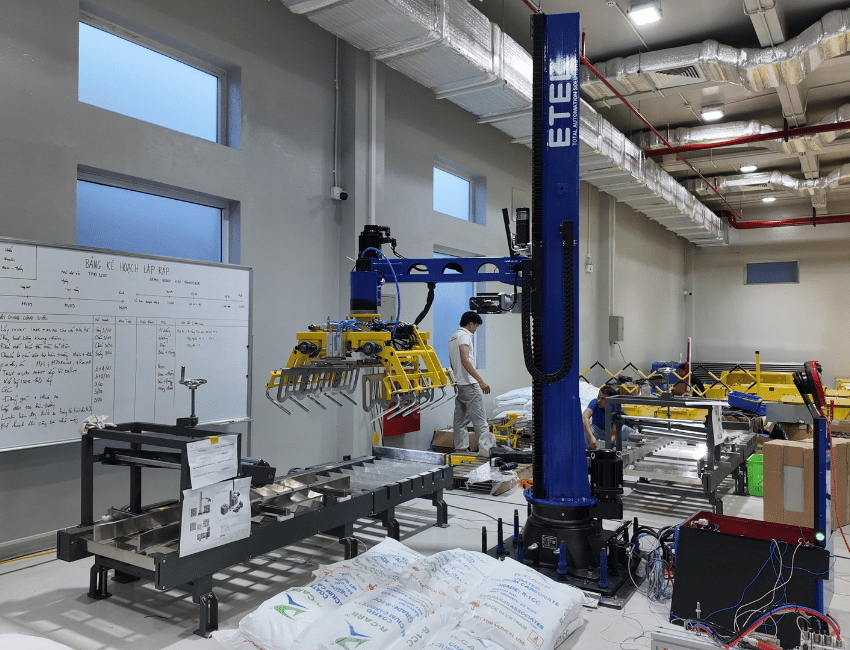
Practical Applications of Depalletizer Robots
- Food & Beverage: Unloading raw material cartons, empty bottles, cans, and packaging supplies for filling lines.
- Chemicals & Paints: Unloading cans and raw material bags, reducing worker exposure to hazardous or dusty environments.
- Packaging & Printing: Feeding carton boxes and paper bundles into packaging machinery.
- Agriculture & Animal Feed: Unloading raw material bags into mixing and batching systems.
- Building Materials: Unloading bags of cement, adhesive, and putty for mixers or repackaging lines.
- Logistics & Warehousing: Unloading inbound goods, sorting, and transferring items onto order-picking conveyors.
- Electronics & Home Appliances: Unloading component boxes and equipment for assembly lines.
Comparing Column-Type Robots with Other Depalletizing Solutions
| Criteria | Column-Type Robot (4-Axis) | 6-Axis Articulated Robot | Cobot |
| Payload | Medium – High (≥80kg) | High | Low (typically under 30kg) |
| Product Flexibility | Good | Very Good | Good (lightweight goods) |
| Complexity | Simple | Higher | Simple |
| Investment Cost | Reasonable | Higher | Medium – High |
| Footprint | Compact | Larger | Small |
| Best Suited For | Unloading diverse boxes/bags, medium-to-high throughput | Mixed-SKU loads requiring high flexibility | Lightweight goods, working alongside humans |
If you need to unload heavy goods up to 80kg, handle changing product types, and strike a balance between cost and durability, a column-type robot is the ideal choice.
How to Choose the Right Depalletizer Robot
- Product weight + gripper weight: The 80kg rating represents the total combined weight of the load and the end-of-arm tooling.
- Dimensions, packaging type, and surface: Carton boxes, soft bags, cans, or plastic crates determine the required gripper type (vacuum, clamp, or fork/scoop).
- Pallet stacking pattern: Are pallets stacked uniformly in a fixed pattern, or are they mixed and irregular? Irregular loads require additional vision cameras or detection sensors.
- Stack height: Cross-check your maximum pallet height against the robot’s 1800 mm vertical stroke and 1700 mm maximum operating height.
- Required throughput: Calculate the required boxes per minute to determine cycle times and whether one or multiple robots are needed.
- Floor layout and installation site: Review the working envelope layout, pallet positions, conveyors, forklift access lanes, and safety fencing.
- Electrical and safety infrastructure: Ensure a ~6 kVA power supply, safety barriers, light curtains/sensors, and emergency stop buttons.
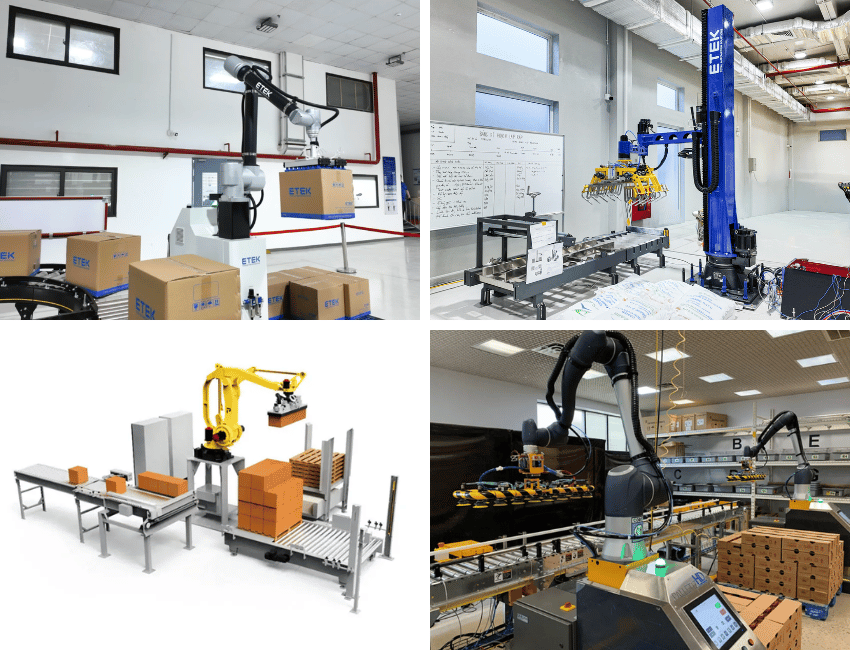
Installation, Operation, and Maintenance of a Depalletizer
Installation: Because the robot weighs approximately 689 kg, the floor must be level, load-bearing, and anchored with bolts according to the base drawing. Once mounted, technicians install the gripper and sensors, connect the conveyors, and calibrate pick-and-place positions.
Operation: Operators input box dimensions, boxes per layer, number of layers, and drop-off positions via the control pendant. Training typically takes only a few days for staff to master basic operations.
Routine Maintenance:
- Clean, inspect, and lubricate axes and guide rails.
- Inspect the gripper, pneumatic lines, and vacuum suction seals.
- Check signal cables, sensors, and safety devices.
- Back up programs and update software as needed.
Environmental Note: The IP40 rating is suited for dry workshops with minimal fine dust. If your facility is humid, heavily dusty, or requires washdowns, consult with the supplier beforehand for protective covers or modifications.
Frequently Asked Questions (FAQ)
How is a depalletizer robot different from a palletizer? A palletizer stacks goods onto a pallet (at the end of a line), while a depalletizer unloads goods from a pallet (at the start of a line). Both can use the same robot model, differing only in programming, gripper design, and line layout.
What is the maximum weight the BRTIRPZ2080A can unload? Up to 80 kg, including the weight of the end-of-arm gripper.
What is the maximum unloading height? It features an 1800 mm vertical stroke and a maximum operating height of approximately 1700 mm, depending on tooling and material specifics.
Can the robot unload pallets with different box sizes? Yes, by switching programs and using an adaptable gripper. For mixed-case or irregular pallets, adding a 3D camera or sensor system is recommended to detect box positions.
Is safety fencing required? Yes. Industrial robots with an 80kg payload require physical safety barriers, sensors, and emergency stop systems.
How does a column-type robot differ from a 6-axis robot? A column-type robot is specialized for palletizing/depalletizing with a simpler structure and lower cost. A 6-axis robot offers greater dexterity for complex orientations but is more intricate and generally more expensive.
What is the payback period (ROI)? It depends on the number of shifts, labor costs, and production throughput. Suppliers can calculate a tailored ROI based on your factory’s actual operational data.
Conclusion
With an 80kg payload, 2000 mm reach, ±0.15 mm repeatability, and 1800 mm vertical stroke, the BRTIRPZ2080A column-type depalletizer robot delivers a well-balanced solution of performance, cost-efficiency, and durability for depalletizing operations. It relieves workers from heavy lifting, ensures steady line feeding, improves workplace safety, and minimizes product damage.
Get a Free Depalletizing Solution Consultation Send us your product type, weight, pallet stacking pattern, target throughput, and factory layout. ETEK’s engineering team will conduct an on-site survey, propose an optimal configuration, simulate the workflow, and provide a detailed quotation.
📞 Hotline: 0866 533 986
📧 Email: info@etek.com.vn
Read more: PALLETIZER SYSTEM – STRUCTURE AND WORKING PRINCIPLE – Packaging Automation