
 Tiếng Việt
5 Common Case Packer Errors and How to Fix Them
Common Types of Case Packer Machines Today
- Top-Load Case Packer: Uses mechanical grippers or vacuum suction cups to drop products from above. Prone to errors related to vacuum suction pressure and servo axis accuracy.
- Side-Load Case Packer: Uses a horizontal pusher mechanism to insert collated product groups into pre-opened cases. Commonly experiences pusher jams or case blank dimension discrepancies.
- Wrap-Around Case Packer: Wraps a flat corrugated blank directly around the product group before sealing with adhesive tape or hot-melt glue. Sensitive to cardboard creasing line quality and glue nozzle temperature.
- Robotic Case Packer: Utilizes multi-axis robotic arms (Delta or Articulated) integrated with machine vision. Errors primarily involve conveyor encoder signal synchronization and picking coordinate calibration.
5 Common Case Packer Errors and Troubleshooting Methods
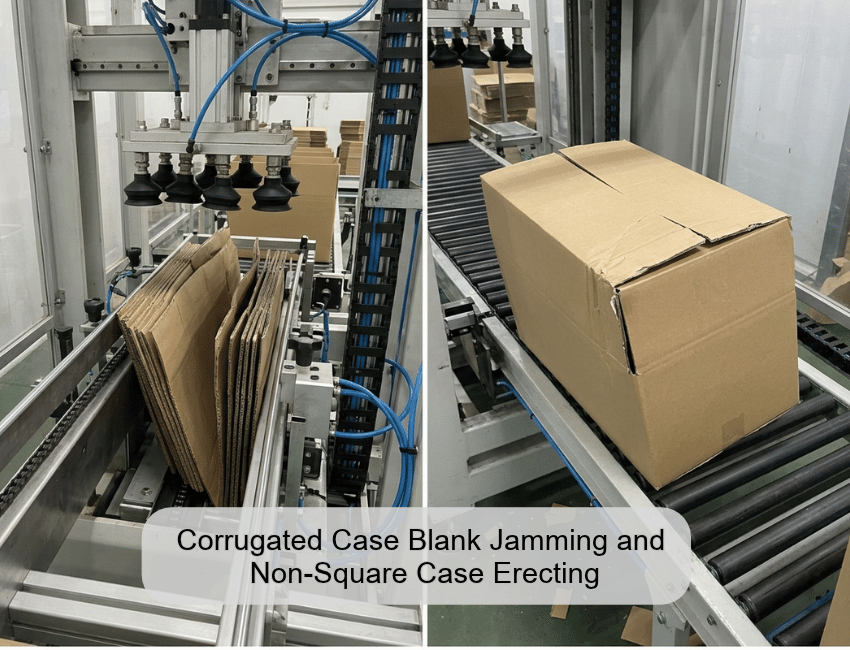
Corrugated Case Blank Jamming and Non-Square Case Erecting
- Vacuum suction cups fail to pick up a cardboard blank from the magazine, or pick up 2–3 blanks stuck together simultaneously.
- Erected cases are skewed into a parallelogram shape without 90-degree corners, preventing products from entering smoothly.
- Case blanks get tightly jammed at the guide rails or bottom-folding assembly.
- Inconsistent cardboard blank quality: Corrugated boards stored in high-humidity environments become soft and warped, or shallow creasing lines create excessive resistance when opening the case.
- Degraded vacuum system: Rubber suction cups are worn, hardened, or cracked, or the vacuum generator is clogged with paper dust.
- Mechanical misalignment in the magazine: Magazine retaining stops are set too tightly (preventing suction cups from pulling blanks out) or too loosely (causing blanks to slip out of alignment).
- Inspect input materials: Ensure cardboard blank moisture stays within 8%–12%, with warping not exceeding 3 mm on a flat surface. Lightly pre-break (flex) the creasing lines before loading blanks into the magazine.
- Clean and replace suction cups: Use compressed air to blow out paper dust from the vacuum filter. Replace the entire set of suction cups once they lose elasticity rather than replacing single cups individually to ensure balanced suction force.
- Adjust guide rails: Calibrate the clearance of the magazine retaining stops so they hold the blanks upright firmly while still allowing smooth layer separation when the suction cups pull back.
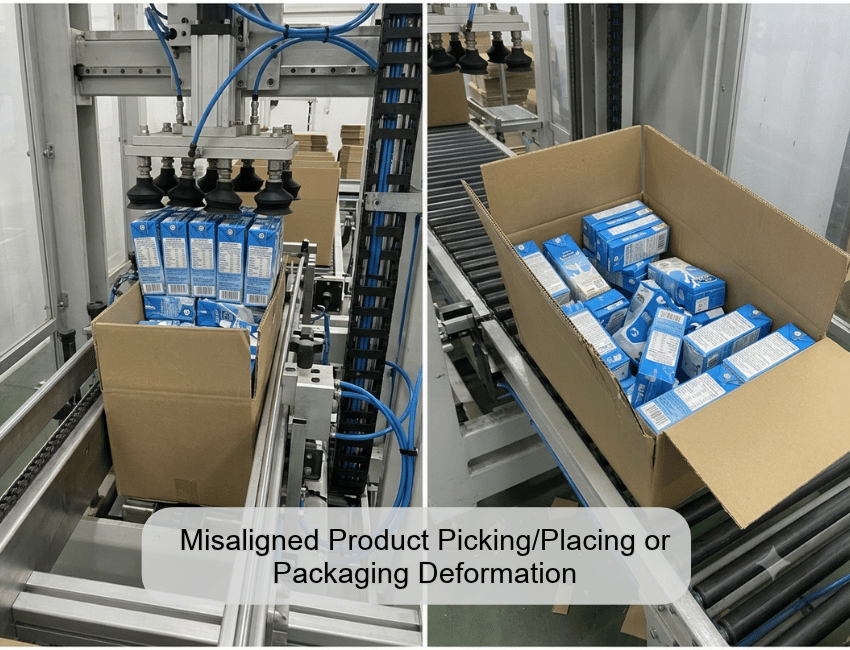
Misaligned Product Picking/Placing or Packaging Deformation
- The gripper drops products off-center from the case opening, causing them to catch on the cardboard flaps or walls.
- Products drop mid-air while transferring from the infeed conveyor into the case.
- Excessive horizontal pushing force dents paper boxes or disrupts the collated product formation.
- Servo motor home position drift: After prolonged continuous operation at high speeds, timing belts stretch or coordinate parameters on the VFD/servo drive deviate.
- Photoelectric sensors misdetecting product position: Dust buildup on sensor lenses or vibration-induced angle shifts cause the machine to misread when a product group is fully collated.
- Uneven gripping force or suction pressure: Compressed air pressure supplied to the gripper head falls below design thresholds, or an unsuitable suction cup type is used for rough, uneven packaging surfaces.
- Recalibrate mechanical coordinates: Return all motion axes to their home (zero) positions, check timing belt tension, and tighten shaft couplings.
- Clean and align sensors: Wipe photoelectric sensor lenses with a soft cloth and verify status indicator lights with and without products passing through to ensure accurate sensitivity.
- Optimize End-of-Arm Tooling (EOAT): Adjust flow control valves to decelerate the gripper arm at the end of its stroke (cushioning), and check the pressure gauge to maintain a stable 0.5–0.6 MPa.
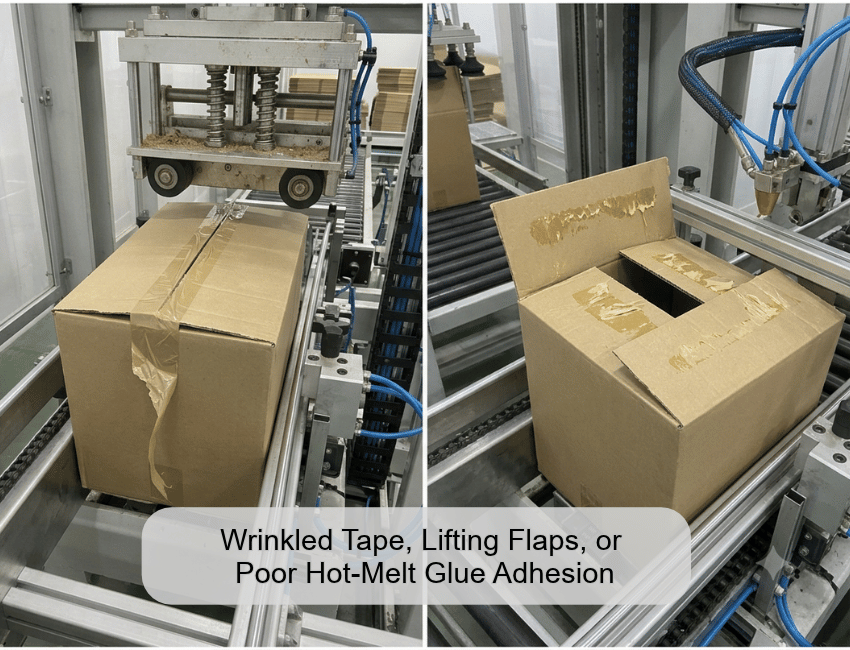
Wrinkled Tape, Lifting Flaps, or Poor Hot-Melt Glue Adhesion
- For tape sealers: Adhesive tape is applied off-center from the flap seam, wrinkled, folded over, or the cutter blade fails to sever the tape completely, leaving a trailing tail.
- For hot-melt glue sealers: Glue beads are dispensed intermittently, the adhesive cools and sets too quickly before the flaps are compressed together, or excess glue overflows and stains the case.
- Worn or glue-fouled cutter blades: Accumulated paper dust and adhesive residue dull the tape cutter blade over time, while wipe-down roller return springs weaken.
- Incorrect hot-melt temperature and open time: Glue tank temperatures set too low prevent the adhesive from reaching proper viscosity to penetrate cardboard fibers; conversely, excessively high temperatures char (carbonize) the glue and clog the nozzles.
- Insufficient side-belt compression: Side drive belts are worn or spaced too wide relative to the actual width of the case.
- Maintain the cutter and roller assembly: Clean the cutter blade with specialized solvent and replace it if chipped. Adjust the tape roll tension knob moderately so the tape adheres smoothly without over-stretching.
- Set standard system temperatures: Configure tank, hose, and nozzle temperatures according to the adhesive manufacturer’s specifications (typically 160°C to 180°C). Flush and clean nozzles periodically with specialized purging solution.
- Tighten side-belt spacing: Narrow the gap between the two side drive belts so the top flaps meet tightly before passing under the compression rollers.
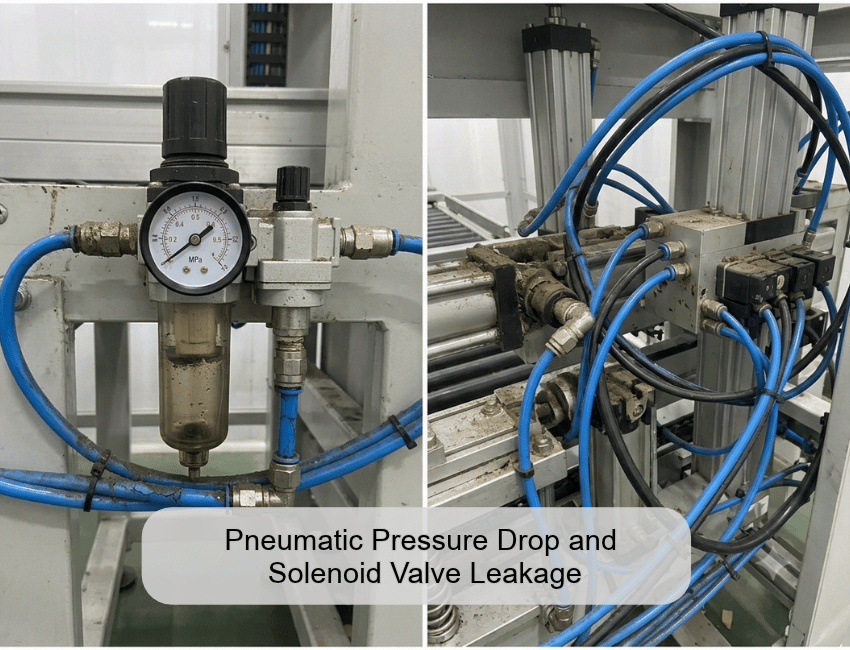
Pneumatic Pressure Drop and Solenoid Valve Leakage
- Pneumatic cylinders move jerkily or complete their strokes slower than normal, falling out of sync with other mechanical assemblies.
- The HMI screen repeatedly triggers alarms and initiates emergency stops.
- Audible air hissing occurs around push-in fittings or the solenoid valve manifold.
- Clogged air preparation unit (FRL): Water separator and particulate filter elements are not drained or replaced regularly, restricting airflow into the machine.
- Condensation in air lines: Compressed air from the central compressor system is inadequately dried, causing moisture buildup that corrodes solenoid valve spools and degrades internal cylinder seals.
- Aged pneumatic tubing: Air hoses undergoing continuous flexing along moving arms become kinked or cracked at push-in connectors.
Solutions:
- Inspect the FRL unit: Drain accumulated water from the filter bowl at the start of every shift; clean or replace the filter element if the pressure drop across the unit exceeds 0.05 MPa.
- Locate and fix leaks: Use soapy water or an ultrasonic leak detector to inspect all push-in fittings, and immediately replace stiff or cracked PU tubing.
- Service the solenoid valve manifold: Inspect solenoid coils and clean valve spools if mechanical sticking is detected; replenish pneumatic lubricator oil if the cylinders require lubricated air.
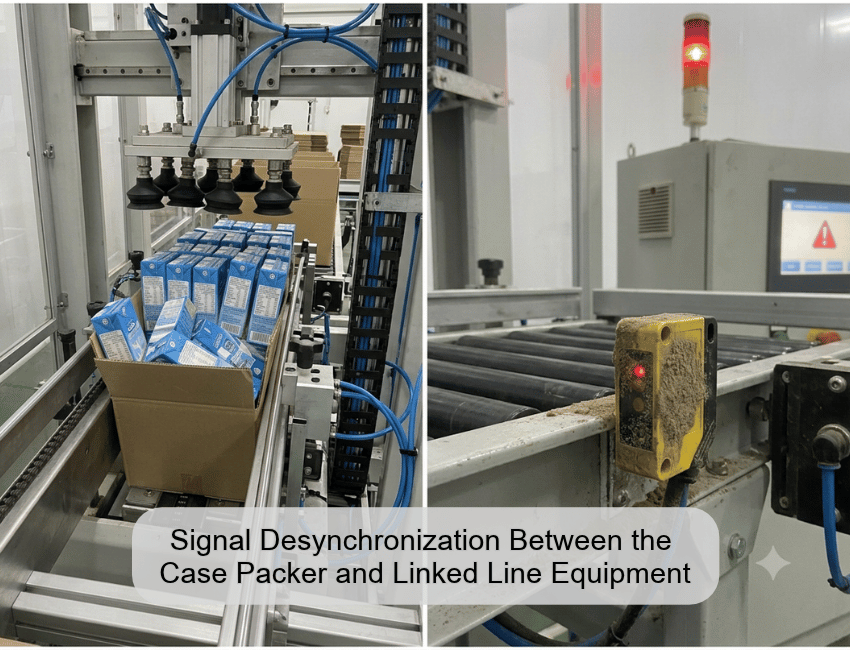
Signal Desynchronization Between the Case Packer and Linked Line Equipment
In an integrated automatic packaging line, the case packer does not operate in isolation-it must continuously communicate with upstream primary packaging machines and downstream labelers or palletizers.
Symptoms:
- Products on the infeed conveyor back up and topple over before entering the case packer’s lane divider.
- The case packer triggers an outfeed-full alarm and halts operation even though the downstream conveyor is empty.
- The machine stops unexpectedly mid-cycle without any apparent mechanical fault.
Root Causes:
- Interference or misalignment on infeed/outfeed photoeyes: Strong ambient lighting, reflective packaging surfaces, or accidental obstructions trick the PLC into misreading conveyor accumulation states.
- Conveyor speed mismatch: Infeed conveyor speed does not match the actual packing throughput of the case packer, causing product starvation or over-accumulation.
- Loose industrial communication connectors: Long-term mechanical vibration loosens I/O signal wires or communication network cables linking control cabinets.
Solutions:
- Check I/O status on the control cabinet or HMI: Cross-reference physical indicator LEDs on each photoelectric sensor against PLC input states to pinpoint faulty or stuck sensors.
- Recalibrate conveyor VFDs: Adjust frequency and acceleration/deceleration parameters on intermediate conveyor VFDs to ensure smooth, steady product flow into the lane divider.
- Secure signal cabling: Inspect and tighten all communication connectors, and route sensor signal cables separately from high-power motor cables to prevent electromagnetic interference (EMI).
Quick Troubleshooting Reference Table for the Shop Floor
Maintenance technicians can save the reference table below to shorten fault isolation time when a case packer error occurs during a production shift:
| Functional Unit | Common Symptoms | Priority Root Causes to Check | Quick Corrective Actions |
| Case Feeding & Erecting | Fails to pick blanks; erected cases are skewed | Damp/warped cardboard; worn suction cups; low vacuum pressure | Flip/replace warped blanks; clean vacuum filter; adjust magazine stops |
| Product Collating & Loading | Misaligned drops; dropped items; dented packaging | Servo home position drift; miscounting sensors; low gripping pressure | Execute servo homing cycle; wipe photoeye lenses; increase air pressure |
| Case Sealing | Wrinkled/uncut tape; popping hot-melt flaps | Dull cutter blade; wrong glue tank temp; loose side belts | Clean/replace blade; verify nozzle temp (160–180°C); tighten side-belt gap |
| Pneumatic System | Sluggish cylinders; low-pressure HMI alarms | Clogged FRL filter; water in air lines; leaking PU fittings | Drain FRL filter bowl; check main pressure (0.5–0.6 MPa); replace cracked tubing |
| Control & Synchronization | Infeed product backup; false outfeed-full stops | Reflective sensor interference; VFD speed mismatch; loose PLC cables | Realign/tune sensor sensitivity; sync conveyor frequencies; tighten I/O connectors |
Preventive Maintenance Procedures to Reduce Case Packer Failures
Rather than waiting for line downtime to perform repairs, maintaining a preventive maintenance schedule extends equipment lifespan and stabilizes packaging throughput:
Per Shift (Daily):
- Drain accumulated water from the FRL pneumatic filter bowl before starting the machine.
- Use an air blow gun to clear paper dust and cardboard debris from photoelectric sensors, vacuum suction cups, and linear guide rails.
- Check adhesive pellet levels in the melt tank (for hot-melt systems) to prevent tank starvation and char buildup.
Weekly:
- Clean the tape cutter blade and inspect the elasticity of top-flap compression rollers.
- Inspect all rubber suction cup surfaces and immediately discard any showing signs of cracking or deformation.
- Check the tension of drive belts and conveyor chains.
Monthly / Quarterly:
- Apply manufacturer-specified grease to bearings, ball screws, and linear guideways.
- Inspect and tighten all terminal blocks inside the PLC control cabinet and verify grounding points.
- Evaluate overall mechanical backlash in couplings and replace wear parts (cylinder seals, air filter elements) on schedule.
ETEK – Trusted Case Packer Solution Provider, Your Lifelong Factory Partner
With extensive experience deploying automation projects across the F&B, pharmaceutical, and FMCG industries, ETEK is proud to be a leading consultant, designer, and provider of Case Packer solutions in Vietnam.
- Tailored Practical Solutions: On-site factory surveys to engineer machine configurations that synchronize seamlessly with your specific packaging characteristics and existing production lines.
- Transparent Warranty & In-Stock Spare Parts: Comprehensive, long-term OEM warranty policies backed by locally stocked consumables and spare parts (suction cups, sensors, cutter blades, solenoid valves, etc.) to minimize replacement lead times.
- 24/7 Technical Support: A team of highly skilled engineers supporting you throughout the entire project lifecycle—from operator training and scheduled maintenance to rapid remote diagnostics and on-site troubleshooting.
- Contact ETEK via etekpack.com or hotline 0866 533 986 for an on-site engineering survey and consultation on the most effective automated packaging solution for your business.