
 Tiếng Việt
CARTON ERECTOR – STRUCTURE AND OPERATING PRINCIPLE
A carton erector (also known as a carton opening machine) is automated equipment designed to take flat carton blanks, open them into a box shape, fold the bottom flaps, and seal the bottom with adhesive tape or hot-melt glue. This machine helps factories standardize box forms, increase productivity, and reduce labor dependency at the initial stage of the packaging line.
This article explains what a carton erector is, its common types, structure, operating principles, proper operating procedures, and key criteria to consider before investing.
What is a carton erector?
Carton Erector is packaging equipment that executes a sequence of operations: picking up flat blanks → vacuum-opening them into boxes → shaping → folding bottom flaps → sealing the bottom. The finished box has right-angled corners, a securely sealed bottom, and is ready for the product loading stage (via a case packer or manual packing).
Comparing manual carton erecting vs. automatic carton erectors:
| Criteria | Manual Carton Erecting | Automatic Carton Erector |
| Speed | Depends on workers, decreases over the shift | Stable based on machine settings |
| Box Quality | Inconsistent, prone to misaligned flaps and crooked tape | Consistent box form and tape lines |
| Labor | Requires many workers during peak hours | One worker loads blanks for the whole machine |
| Suitability | Low output, various odd sizes/specifications | Steady output, needs line automation integration |
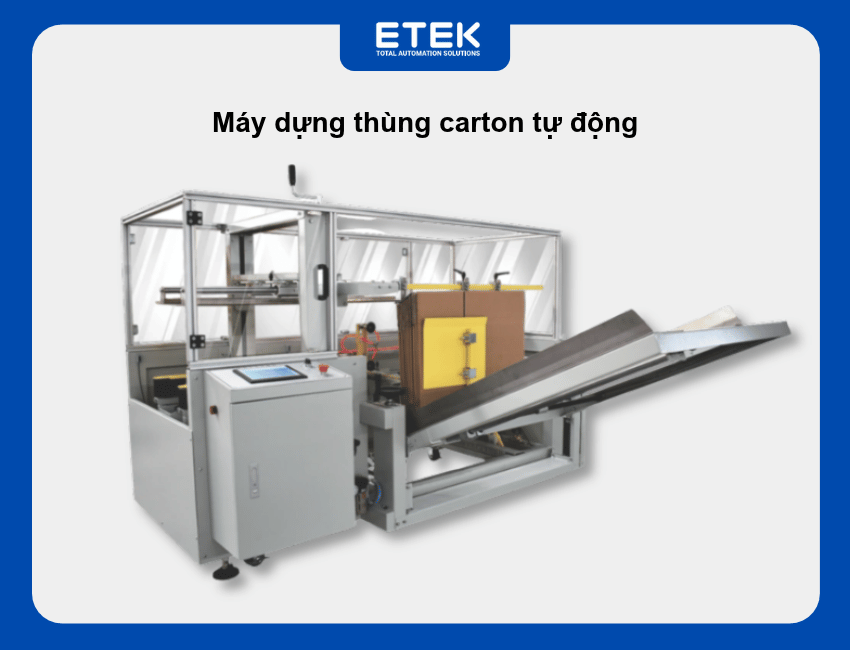
Classification of Carton Erectors
Vertical Carton Erector: Blanks are stacked at an incline or vertically in the magazine. The machine uses vacuum suction to open the box, folds the bottom flaps, seals it with adhesive tape, and discharges the box in an upright position. This is the most popular series due to its compact design, easy operation, and reasonable cost—ideal for standard boxes sized 30 cm and above.
Horizontal Carton Erector: A sliding mechanism pulls the blank out of the magazine, vacuum arms expand the box, fold one side flap, and apply tape. The finished box is discharged horizontally. This type is less common but offers high-speed advantages because its movement is optimized for continuous cycles.
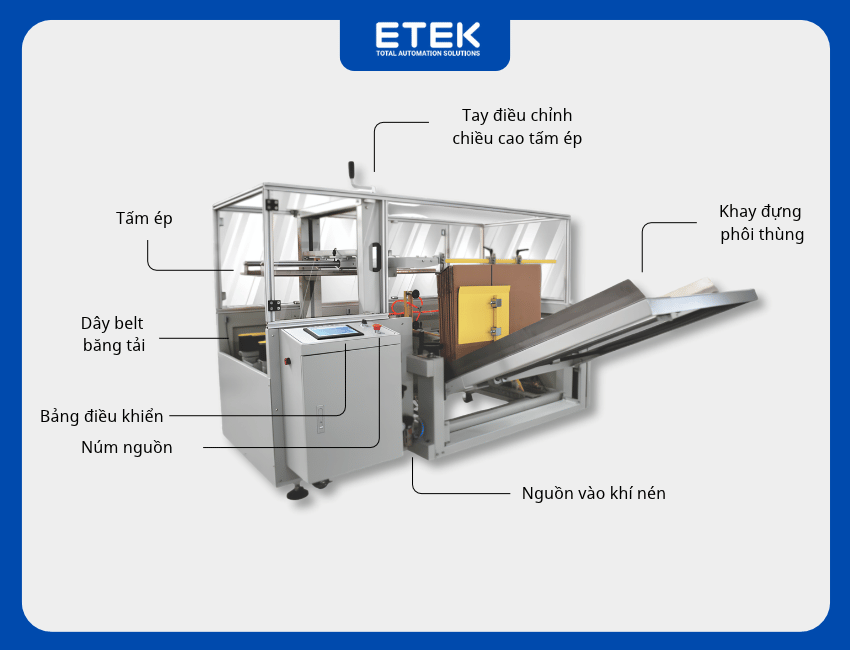
Main Components of an Automatic Carton Erector
- Carton Blank Magazine: The storage area where flat corrugated sheets are loaded. Its design allows convenient loading while the machine is running. Reference capacity is 80–100 blanks, depending on 3-ply, 5-ply, or 7-ply board thickness.
- Vacuum Suction Cup System: Pneumatically driven suction cups grip the cardboard surface and pull it open into a box shape. Stable suction power determines the success rate of box opening.
- Forming Mechanism: Holds right angles after opening to prevent warped or misaligned boxes.
- Bottom Flap Folding Unit: Mechanical folding arms combined with pressing force fold the bottom flaps neatly along the crease lines.
- Bottom Sealing Head: Dispenses and presses adhesive tape (or applies hot-melt glue) onto the seam of the folded bottom flaps.
- PLC Control System and Touchscreen Interface: Coordinates the entire cycle synchronously, allowing operators to save and recall settings for different box specifications.
- Machine Frame, Outfeed Conveyor, and Sensors: Sensors detect empty blank magazines, tape run-outs, or box jams, triggering error alerts on the screen.
Operating Principle of a Carton Opening Machine
While different machine types may vary in design, most carton opening machines follow these basic steps:
- Blank Feeding: Operators stack flat carton blanks into the storage magazine. The machine’s suction plate automatically advances to pick up each cardboard sheet.
- Vacuum Suction and Box Opening: Vacuum suction cups attach to the cardboard surface and pull the flat sheet into a rectangular box shape.
- Box Shaping: The forming mechanism holds the four right-angled corners and secures the dimensions according to the preset specifications.
- Bottom Flap Folding: Once the box is formed, the bottom folding heads are controlled to fold the bottom flaps into the required shape.
- Carton Bottom Sealing: The sealing head dispenses adhesive tape (or applies hot-melt glue) and firmly presses it against the bottom of the box to ensure a secure seal.
The entire process is managed via a smart control screen, allowing the machine to run fully automatically from start to finish-achieving high speed and exceptional precision.
Reference Technical Specifications
Note: The technical specification table below is for reference only, as individual carton erector models may have different specifications.
| Technical Specifications | Details |
| Model |
K30TBK |
| Carton Dimensions |
L130-280 × W80-170 × H90-200mm (Customizable dimensions) |
| Tape Width |
48mm |
| Working Speed |
20 – 25 cartons/min |
| Machine Dimensions |
L206mm × W158mm × H1391mm |
| Power Supply |
220V 50Hz 1P |
| Power Consumption |
1200W |
| Compressed Air Pressure |
0.6 – 0.8 MPa, 450Nl/min |
| Net Weight / Gross Weight |
500kg / 650kg |
| Table Height |
650mm |
| Erecting Method |
Vertical carton erecting driven by Servo motor |
Industry Applications
- Food and Beverage: Standard cartons, steady output, high speed.
- Household Appliances and Electronics: Various carton sizes, requiring flexible specification changes.
- Pharmaceuticals and Cosmetics: Requires clean boxes, standardized forms, and easy batch traceability.
- Furniture and Woodworking: Large boxes, heavy-duty cardboard, often requiring hot-melt glue sealing.
- E-commerce and Logistics: High-volume carton erecting demands across multiple sizes.

Safe Operating Guidelines
Operating Procedures
Procedures may vary depending on the machine model; always refer to the manufacturer’s user manual.
- Pre-operation Check: Inspect the motor, conveyor belts, tape cutting blades, compressed air pressure, sensors, and emergency stop buttons.
- Set Box Specifications: Adjust the spacing of the forming mechanism and folding arms according to the box dimensions (or recall a saved recipe/program).
- Load Blanks and Tape: Stack the blanks neatly into the magazine (reference capacity: 80–100 blanks depending on thickness), and install the tape roll correctly into the sealing head.
- Power On and Select Mode: Turn on the main power switch and select the appropriate speed on the touchscreen interface.
- Test Run: Check for proper right angles, tight bottom flap closure, and ensure the tape line is not misaligned or loose before proceeding with mass production.
- Monitor Operation: In the event of a blank jam or system fault, press the emergency stop button and disconnect the compressed air supply before reaching inside to resolve the issue.
- End of Shift: Turn off the power, vent the compressed air, clean paper dust, and tidy up the surrounding machine area.
- Safety Precautions: Do not insert hands into the folding or sealing areas while the machine is powered or pressurized; only trained personnel are permitted to adjust mechanical components; perform periodic inspections of safety guards and sensors.
Common Troubleshooting Issues
| Symptom | Common Cause | Solution |
|
Fails to pick up blanks or drops blanks |
Dirty/worn suction cups, low air pressure, warped cardboard |
Clean or replace suction cups, check air pressure, store blanks flat |
|
Deformed box after opening |
Incorrect forming distance setting, cardboard is too thin/soft |
Recalibrate forming mechanism, consider a dual-side vacuum machine |
|
Misaligned bottom flap folding |
Poor blank creasing quality, folding arms improperly positioned |
Inspect crease line quality, readjust folding arms |
|
Misaligned, loose, or wrinkled tape |
Incorrect tape roll installation, dull cutting blade, unadjusted sealing head |
Reinstall tape roll, replace blade, adjust sealing head |
|
Blank jam at the magazine |
Blanks stuck together, overloaded magazine, or incorrect sizing |
Separate blanks before loading, load within capacity limits |
Refer to the video below for the operation of the carton erector:
How to Choose a Carton Erector
- Box Dimension Range: The machine must cover all carton sizes currently in use. If sizes change frequently, prioritize machines with automatic adjustment features or programmable recipe storage.
- Cardboard Blank Quality: For thin or easily warped cardboard, opt for a dual-side vacuum suction mechanism to ensure square opening and reduce jams.
- Line Speed Synchronization: Machine capacity must align with downstream case packers and carton sealers to prevent bottlenecks.
- Sealing Method: Adhesive tape for standard goods; hot-melt glue for heavy loads, cold storage, or export applications.
- Footprint, Power, and Pneumatics: Verify installation dimensions, power supply, and available compressed air pressure.
- Components and After-Sales Support: Prefer machines using standard commercial components with readily available spare parts, warranties, and on-site technical support.
- Trial Run with Actual Blanks: Request the supplier to perform a test run using your actual box samples before making a final decision.
Automatic Carton Erector Quotation at ETEK
ETEK designs and integrates automatic carton erectors tailored to each factory’s specific box designs and production capacity. The machine can be directly connected with case packers, carton sealers, and palletizing robots to form a seamless production line.
Control components, sensors, and pneumatic systems are sourced from widely recognized brands in industrial automation such as Schneider Electric, Siemens, Xinje, etc., ensuring convenient maintenance and component replacement.
Working Process with ETEK
- Survey: Engineers evaluate the facility footprint, production capacity, and carton specifications.
- Trial Run: Test runs are conducted using your actual blank samples.
- Configuration Proposal: Select the machine model, sealing method (tape or hot-melt glue), and integration plan with other machines on the line.
- Installation and Handover: Provide installation support, operational training, and warranty coverage as committed.
Contact ETEK today (Hotline: 0866 533 986) for in-depth consultation and to receive the most optimized quotation for an automatic carton erector for your business!