
 Tiếng Việt
DETAILED COMPARISON OF HORIZONTAL AND VERTICAL CASE PACKERS, AND THEIR APPLICATIONS
The Case Packer plays a pivotal role at the end-of-line packaging stage, directly determining dispatch speeds and package sealing quality. However, many businesses still struggle to compare vertical and horizontal carton case packers to make the right investment decision. This article provides an in-depth analysis of the operating principles, pros and cons, and practical applications of each automated case packing line, helping you select the most optimal solution for your plant.
What is a Case Packer?
A case packer is specialized automation equipment positioned at the end of a production line. The machine receives individual primary-packaged products delivered via conveyor belt, automatically collates them, and packs them into carton cases quickly and accurately.
Case packers offer high flexibility, making them suitable for a wide range of products—from food and beverages to pharmaceuticals, cosmetics, and fast-moving consumer goods (FMCG). Integrated with modern technologies, these machines achieve exceptional operational output, optimized for large-scale production lines while maintaining high precision and finish quality.
What Types of Case Packers Are Available?
To accommodate the wide variety of packaging types on the market, automated case packing technologies have evolved into several machine designs. Depending on the classification criteria, case packers are divided into the following main categories:
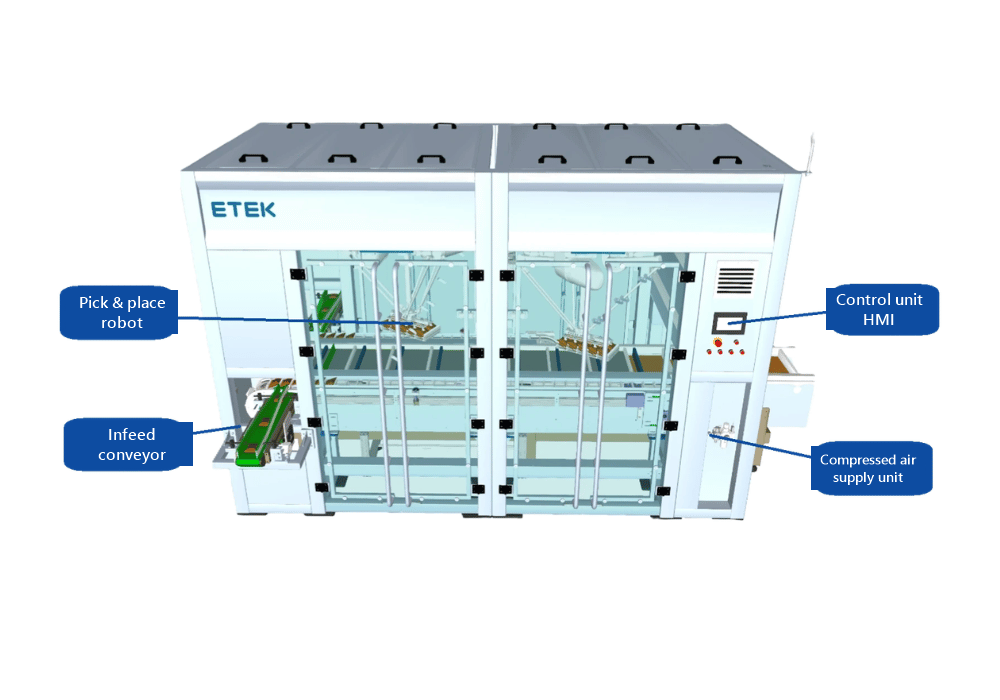
- Top-Load Pick and Place Case Packer: Integrates robotic arms to automatically pick products from the conveyor and load them into the case from above. This solution is optimal for fragile, impact-sensitive, or complex-shaped items.
- Drop-Style Case Packer: Also known as top-loading case packers, these arrange and drop products vertically into carton cases. This equipment is particularly effective when handling larger-sized goods.
- Horizontal End-Load / Side-Load Case Packer: Operates horizontally, continuously moving and pushing products into the side of the case during conveyor transport.
- Máy Wraparound kiểu linear Case Packer: The carton blank forming and folding process takes place directly around the products, ensuring a snug, form-fitting package. This is an ideal choice for products with non-uniform dimensions.
Case packers can operate as standalone units or be seamlessly integrated into automated packaging systems. Investing in this equipment boosts productivity, optimizes accuracy, reduces labor costs, and enhances product protection throughout distribution.
Comparing Horizontal and Vertical Case Packers
To help businesses make effective and optimal investment choices, below is a comprehensive comparison between vertical and horizontal carton case packers based on operating principles, applications, technical criteria, and real-world deployment experience.
Operating Principles
While both share the common goal of loading products into carton cases, their movement methods and product-loading mechanisms differ entirely.
Operating Principle of Horizontal Case Packers
The operating principle of a horizontal case packer is executed automatically through 4 simple steps:
- Product Infeed: The conveyor feeds products (pouches, cans, boxes, etc.) into the machine, automatically collating them into groups according to preset quantities.
- Case Erecting: The carton case is pre-erected with open flaps and held securely in a horizontal orientation.
- Product Loading: A robot (or mechanical pusher) uses vacuum/gripper heads to push the entire collated product group horizontally into the side of the case.
- Case Sealing: The fully loaded case is transferred to a tape/hot-melt glue sealing machine for complete closure.
Operating Principle of Vertical Case Packers
Instead of loading products horizontally, vertical case packers drop products from above into the carton case. The machine operates on the following basic steps:
- Product Infeed: The conveyor feeds products (jugs, bottles, boxes, etc.) in and automatically collates them into groups.
- Case Erecting: The carton case is erected squarely and stands upright with its top flaps open.
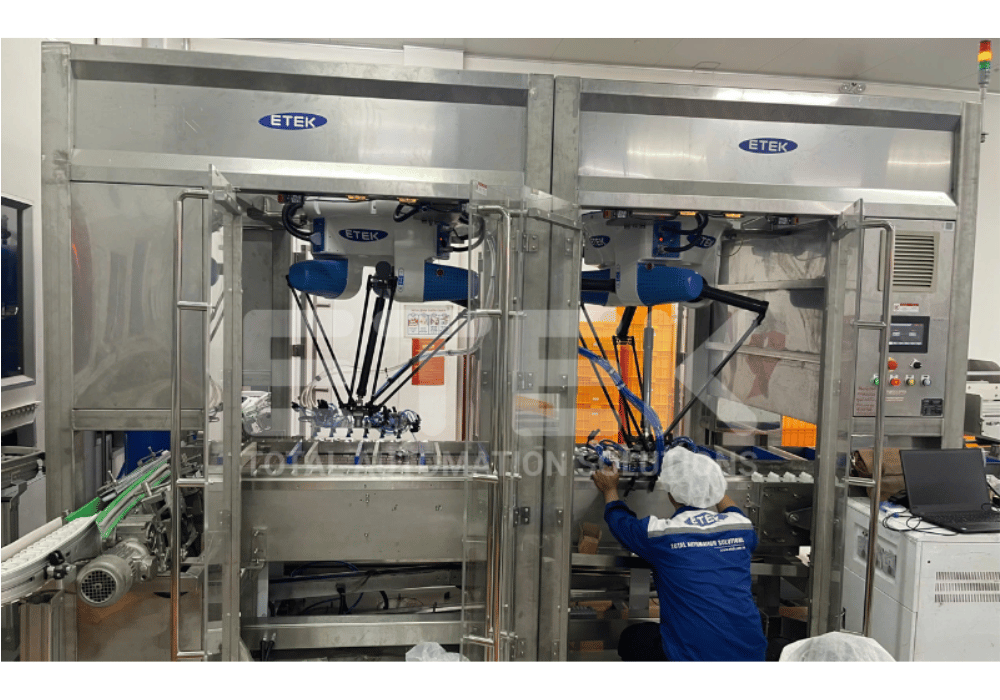
- Pick & Drop Loading from Above: A robot (or mechanical gripper) picks up the product group and drops or places it down into the carton case.
- Case Sealing: The fully loaded case is moved to a top-case sealer for final closure.
Applications for Each Type of Case Packer
Products Suitable for Horizontal Case Packers
Horizontal case packers are particularly optimized for small-sized products, flexible pouches, or rigid box packaging due to their horizontal pushing/picking mechanism.
Flexible Pouches and Soft Bags:
- Stick packs: Instant coffee sachets, sugar packets, seasoning mix, sauces, probiotics, etc.
- Pillow pouches: Snack bags, instant noodle packets, candy bags, seasoning pouches, etc.
Rigid Boxes and Containers:
- Paper boxes, small carton boxes, pharmaceutical boxes, tea boxes, confectionery boxes.
- Metal cans (milk cans, beverage cans), plastic jars, rigid bottles.
Products Suitable for Vertical Case Packers
Vertical case packers operate using a top-down pick-and-place mechanism, allowing them to handle a diverse range of packaging formats:
- Flexible Soft Packaging: Snack pouches, 3-in-1 coffee sachets, seasoning packets, refill fabric softener pouches, instant noodle packs, agricultural product bags.
- Glass Bottles and Fragile Items: Wine bottles, glass soy sauce bottles, pharmaceutical vials, perfume bottles.
- Round, Flat, or Complex-Shaped Plastic Bottles: Shampoo, body wash, toner, and thermal mist spray bottles.
- Multi-Tier Packing with Partition Dividers: Cases requiring 2–3 layers of products that need shock-absorbing partitions inserted or cardboard pads placed between tiers.
Additional Comparison Criteria
Below is a summary table comparing vertical and horizontal carton case packers based on core technical parameters and criteria:
| Comparison Criteria | Vertical Case Packer | Horizontal Case Packer |
| Product Loading Direction | Vertical drop/place from above | Horizontal pick & push into the side |
| Optimal Packaging Format | Bottles, jars, pouches, loose or upright products | Blister packs, tubes, pouches, trays, flat products |
| Speed | Depends on stability during product drop/placement | High speed for stable, rigid, and collated products |
| Footprint / Space Requirement | More compact (utilizes vertical height) | Longer footprint (requires horizontal pushing conveyor space) |
Common Mistakes When Selecting a Case Packer
Throughout consulting and deploying automation systems for hundreds of manufacturing facilities, ETEK has identified several common pitfalls businesses encounter when choosing a case packer:
-
Focusing Solely on Initial Cost
To save upfront costs, many businesses select a case packer that is ill-suited for their current or future product lineup. Packaging formats like bottles, blister packs, tubes, and pouches may all require carton cases, but they cannot be loaded in the same way. This leads to higher product defect rates, resulting in financial loss and wasted materials.
-
Focusing Solely on Machine Speed
A common mistake is choosing equipment based purely on rated speed. A high-speed case packer offers no benefit if the infeed system cannot keep up. Product spacing, orientation, and carton opening quality can degrade overall throughput long before the machine reaches its rated speed.
-
Choosing Poor-Quality Cartons
Carton quality is critical to smooth packaging operations. Cartons with weak scores, soft corrugated board, or uneven folds can cause major jamming issues during erecting, loading, and closing. Machine selection and carton design should always be evaluated together.
-
Partnering with Integrators Lacking System Engineering Expertise
An automated case packer is a complex integrated system combining mechanical engineering, electronics, pneumatics, and PLC control programming. Choosing a vendor that merely sells standalone equipment without an experienced engineering team will leave businesses struggling when technical issues arise or when customization is required.
Automated Carton Case Packing Solutions from ETEK
As an automation leader with over 20 years of experience in Vietnam’s industrial sector, ETEK Automation Solution Joint Stock Company provides turnkey, custom-engineered automated carton case packing solutions tailored to each plant’s specific requirements. ETEK has proven its technical capabilities as a key equipment supplier for major multinational corporations such as Orion, Unilever, and Huu Nghi.
Why Do Major Corporations Choose ETEK?
-
Custom Engineering: ETEK does not offer “one-size-fits-all” solutions. Understanding that every business has distinct product requirements, ETEK’s team of deep-domain engineers conducts direct on-site surveys, 3D simulations, and custom designs systems to fit your floor plan and packaging characteristics precisely.
-
Advanced Robotic Technology: ETEK masters the integration of high-speed Delta Robots (handling up to 250 products/minute) and versatile 6-axis articulated robots, combined with Vision Check systems for automated defect identification and instant rejection.
-
Smart End-Of-Arm Tooling (EOAT): Custom-designed grippers (vacuum suction, mechanical clamping, bottom-support lifting) protect product aesthetics, preventing bag tears or box dents.
-
Durable & Reliable Operation: Systems are assembled using genuine components from world-class brands to ensure smooth operation with defect rates held to NG ≤ 1%.
-
24/7 After-Sales Support: ETEK provides end-to-end solutions—from consulting, design, installation, and technology transfer to scheduled preventive maintenance.
Conclusion
In industrial packaging in general, and case packer selection in particular, no single design is universally perfect for every production environment. The right choice depends on packaging shape, loading orientation, carton specs, target output, quick-changeover flexibility, and compatibility with existing lines.
Contact ETEK today for in-depth consultation and custom-engineered automation lines for your manufacturing plant!